5 straightforward checks to pick a high-quality window cleaning company

Choosing a dependable window cleaning company can feel confusing — safety, results, and different cleaning methods all matter. This guide lays out five clear criteria you can use to judge a window cleaning provider, so you can hire with confidence. Read how to verify insurance and licensing, evaluate experience and professionalism, compare cleaning methods (with a focus on purified water systems), spot reputation and communication signals, and interpret pricing and guarantees. Each section includes practical checks, short comparison tables, and questions to ask so you can spot red flags and prefer companies that meet professional standards. By the end, you’ll have a short checklist and sample verification script to compare quotes and request a free, custom assessment for properties in Camden and Atlantic Counties, NJ.
Why insurance and licensing matter when hiring a window cleaner
Insurance and licenses protect you by shifting financial and legal risk away from the property owner if something goes wrong. General liability covers accidental property damage; worker’s compensation covers on‑the‑job injuries to crew members; and bonding or specialty policies can address theft or contract disputes. Asking for proof of coverage reduces your exposure to surprise costs and confirms the company follows local rules — especially important for multi‑story work or complicated access. Knowing what policies to request and how to check them makes comparing providers simple and practical.
Which insurance policies should a professional window cleaner carry?

A reputable window cleaning company will carry policies that protect both customers and crews while work is underway. General liability covers damage to glass, frames, or nearby property so you aren’t left paying for repairs. Worker’s compensation handles employee medical and wage claims if someone is hurt on the job, and bonding can provide recourse for theft or contract non‑performance. Together, liability, worker’s comp, and bonding form a practical baseline that signals a mature, responsible operation.
Quick comparison: the table below shows core insurance types and what each typically covers.
| Coverage Type | What It Protects | Typical Customer Benefit |
|---|---|---|
| General Liability | Property damage and third‑party claims | Prevents out‑of‑pocket repair or legal costs |
| Worker’s Compensation | Employee medical and lost‑wage claims | Shields the owner from employee injury litigation |
| Bonding | Theft or contractual non‑performance | Provides financial recourse for loss or breach |
Because these protections matter, insist on seeing insurance documentation before any work begins.
How to verify a window cleaner’s credentials
Checking credentials is simple and revealing. Ask for current insurance certificates and license numbers, then confirm policy status with the insurer or regulator — a legitimate company will welcome that. Look up business registration when available, and watch for reluctance to share proof. If a provider won’t verify coverage, treat that as a red flag and move on. Use a short verification script to standardize questions and compare answers reliably.
Practical five‑step verification checklist:
- Request a copy of the current insurance certificate before booking.
- Ask for the insurer’s name and policy number so you can verify directly.
- Confirm worker’s compensation applies to on‑site crew members.
- Check local licensing or business registration records for the company.
- Note whether the provider supplies written confirmation of coverage.
Once credentials are confirmed, the next major factor is how a company’s experience and professionalism affect the quality and safety of the work.
How experience and professionalism change cleaning quality
Experience and professionalism drive consistent, safe, and efficient results. Seasoned crews spot problems early, work faster with fewer callbacks, and know how different glass and frame types react to treatments. Professionalism shows up as clear contracts, punctual crews, neat uniforms, and written safety procedures — all of which make your experience smoother. Evaluating a provider’s track record helps you decide whether they’ll meet expectations the first time.
Why hire a seasoned window cleaning team?
Experienced teams have seen the common issues before and know which techniques prevent damage. For instance, crews familiar with hard‑water deposits understand when to use demineralization or careful mechanical scraping to avoid etching. On larger jobs, experienced crews handle logistics so work finishes on schedule with minimal disruption. References that show complex jobs completed without incident are a strong signal you’ll get reliable results and fewer re‑cleans.
Experience checklist for interviews and references:
- Ask what types of properties they service and for recent examples.
- Request descriptions of challenging jobs and how they were solved.
- Confirm safety protocols for ladders, harnesses, and high‑reach equipment.
These answers point to the training and certification a quality provider should maintain.
Which training and certifications should window cleaners hold?
Training and certification show a company invests in safe, consistent work. Look for training in equipment operation (water‑fed poles, scaffold and ladder safety), chemical handling for eco‑friendly products, and fall protection for elevated work. Memberships in professional associations and documented in‑house training programs also indicate a focus on quality and compliance. When a provider can describe ongoing training and safety documentation, you can trust they take protection seriously.
Key certifications and training to request:
- Ladder and fall‑protection safety training for window access.
- Water‑fed pole operation and purified water handling procedures.
- Chemical safety and handling for detergents or specialty treatments.
With insurance and experience checked, the cleaning method itself determines how clear and long‑lasting your windows will look.
Which methods and products deliver streak‑free windows?
Streak‑free windows depend on both technique and water quality. Purified water systems remove dissolved minerals that cause spotting, while traditional squeegee‑and‑bucket work relies on skillful drying to prevent streaks. Purified systems use filtration and deionization to eliminate residues, which reduces the need for manual drying and lowers the risk of hard‑water spots and etching. Knowing the pros and cons of each approach helps you pick a company that’s right for your windows, local water, and environmental concerns.
Quick comparison: common approaches and their typical effects.
| Method | Characteristic | Typical Impact on Results |
|---|---|---|
| Traditional squeegee & bucket | Manual drying, technique‑dependent | Good for spot work; higher streak risk if technique varies |
| Purified water system | Mineral‑free water, water‑fed poles | Fewer spots and longer‑lasting clarity |
| Chemical treatments | Detergents or specialty cleaners | Effective on stubborn grime but may affect landscaping if not eco‑friendly |
This shows why many advanced providers favor purified water for consistent, low‑chemical results.
How purified water systems improve cleaning results
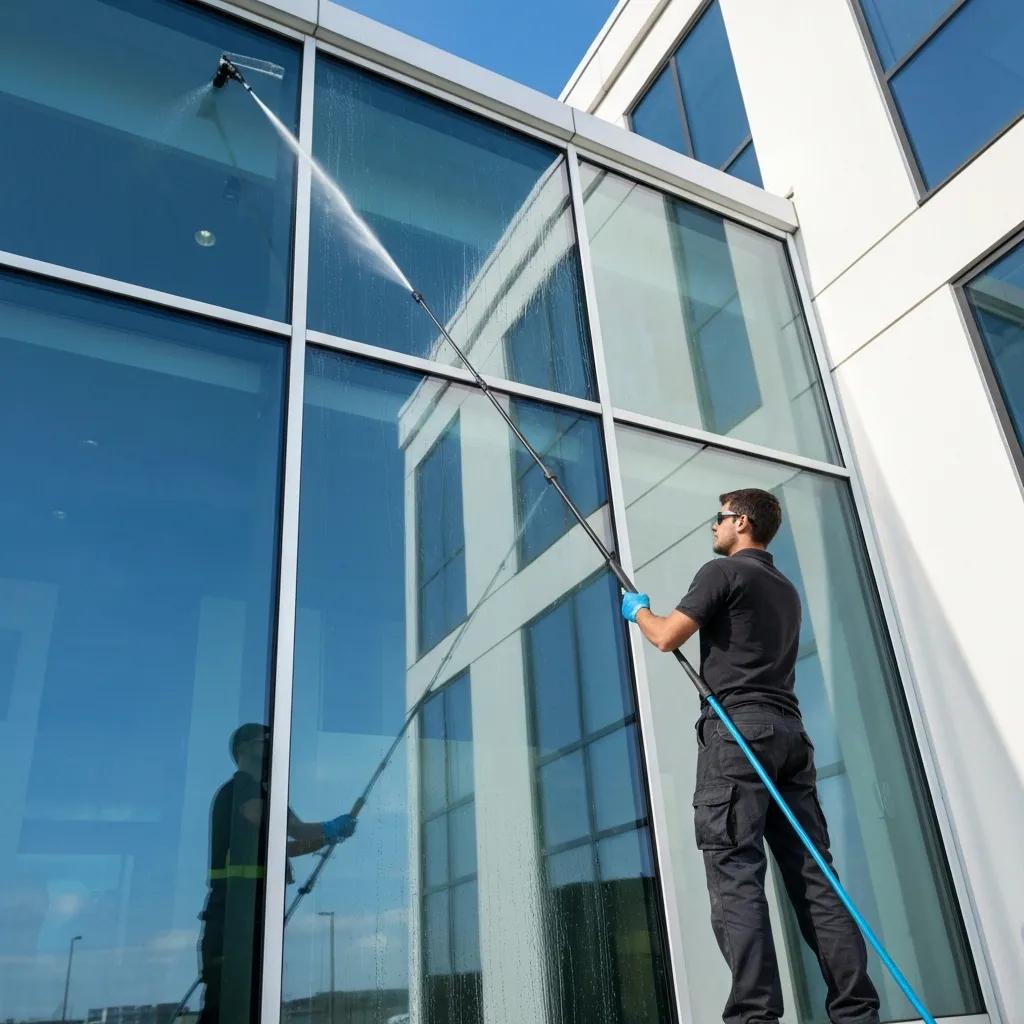
Purified water systems — using deionization or reverse osmosis — remove minerals and dissolved solids that leave film and spots as water dries. With no minerals to cling to glass, windows dry with far less streaking or hard‑water spotting. Purified systems also let technicians clean from the ground with water‑fed poles, reducing ladder use and improving safety. The net result: clearer windows and fewer repeat visits.
Practical benefits of purified water:
- Prevents mineral deposits that form spots and film on glass.
- Reduces the need for chemical cleaners, protecting plants and frames.
- Lengthens time between required re‑cleans versus conventional methods.
After method and performance, many customers also want to know about environmental and health impacts of cleaning products.
Why choose eco‑friendly, non‑toxic products?

Eco‑friendly products reduce health risks for people and pets and limit harmful runoff into storm drains and waterways. When a company uses biodegradable cleaners and minimizes chemical concentrations, the chance of plant damage or indoor air issues drops. Demand for green practices is growing, and reputable providers can explain product ingredients and safety data on request. Choosing a company that prioritizes non‑toxic options protects your home and the local environment.
Checklist for evaluating product claims:
- Ask for ingredient transparency and whether products are biodegradable.
- Confirm the company minimizes chemical use when purified water will do the job.
- Request examples of safe application around plants and delicate surfaces.
Next, look at reputation and communication — strong indicators of how a company operates day to day.
What reputation and communication signals reveal about service quality
Reputation and communication are practical proxies for reliability: review patterns show consistency, and responsiveness shows how a company handles scheduling, scope, and problems. Don’t just read star ratings — look for specifics: do customers mention punctual crews, streak‑free results, and fast resolution of issues? Clear communication — written estimates, arrival windows, and follow‑up policies — reduces misunderstandings. Knowing which signals matter helps you choose a provider that delivers both quality work and a smooth customer experience.
What to look for in reviews and testimonials
Focus on recurring themes that relate to the five criteria: insurance, experience, methods, communication, and guarantees. Helpful signs include repeated praise for streak‑free results, punctual teams, transparent quotes, and documented re‑cleans. Watch for red flags like no‑shows, damage, or refusal to fix problems. Compare reviews across platforms and read details that line up with your priorities.
Practical signals and red flags to watch for:
- Consistent praise for streak‑free results and punctual service.
- Mentions of purified water systems or safety practices.
- Multiple complaints about damage, hidden fees, or poor follow‑up.
Use these review insights to shape the questions you ask when getting a quote or booking service.
How clear communication improves your experience
Clear communication prevents scope and price surprises and creates predictable timelines. Good providers supply written, itemized estimates that list labor, materials, and add‑ons (screens, tracks, heavy stain removal), confirm arrival windows, and give a point of contact for follow‑up. They also explain re‑clean policies and how to request remediation. When a company lays this out upfront, it shows operational maturity and makes the job easier for everyone.
Sample communication timeline and questions to ask:
- Request a written, itemized estimate before scheduling.
- Confirm the arrival window and crew contact procedures for the day of service.
- Ask how to request a re‑clean and what the typical response time is.
With reputation and communication checked, the final area to inspect is pricing transparency and guarantees.
How transparent pricing and clear guarantees protect your investment
Transparent pricing and written guarantees turn uncertainty into manageable expectations by spelling out what’s included and what happens if results aren’t satisfactory. Itemized quotes that list labor, travel, material fees, and special treatments let you compare value instead of just price. Guarantees that state time windows and re‑clean procedures shift risk away from the customer and show the provider stands behind their work. Knowing how to read quotes and what guarantee language to expect helps you avoid surprise fees and choose a company focused on accountability.
How to compare window cleaning quotes
Compare quotes by looking for itemized line items and explicit statements about included surfaces and exclusions. Confirm whether the quote includes screen removal, track cleaning, heavy stain treatment, travel fees, and whether purified water or specialty equipment adds cost. A side‑by‑side checklist for two quotes on the same scope makes gaps obvious. Clear, written pricing usually means the company follows standardized procedures and reduces later disputes.
Sample quote components checklist:
- Base price and which surfaces are included.
- Fees for screens, tracks, or specialized stain removal.
- Travel or access charges, plus whether follow‑up/re‑cleans are included.
This helps you compare real value instead of choosing a low bid that omits important protections.
Quick note: the table below shows common quote line items and what to confirm.
| Quote Component | What to Confirm | Why It Matters |
|---|---|---|
| Base Price | Which surfaces and elevations are included | Ensures apples‑to‑apples comparisons |
| Add‑On Fees | Screens, tracks, heavy stain treatments | Prevents surprise charges after job completion |
| Guarantee Terms | Time window and re‑clean policy | Defines steps if results are unsatisfactory |
Prefer quotes that include clear remediation policies rather than vague language that defers responsibility.
Why a written satisfaction guarantee matters
A written satisfaction guarantee reduces your risk by spelling out how and when a company will correct unsatisfactory work. Guarantees usually include a time window to request a re‑clean, the scope of what’s covered, and any exclusions (for example, pre‑existing damage). Clear guarantee language signals confidence and a commitment to consistent results. Providers who honor written re‑clean policies promptly demonstrate reliability you can count on.
Suggested guarantee wording and evaluation points:
- Look for a written promise to return and correct issues within a specified timeframe.
- Confirm whether labor and materials for re‑cleans are included at no extra charge.
- Ask for the process to request a re‑clean and expected response times.
Companies with specific, enforceable guarantee terms are easier to work with and reduce post‑service hassle.
Useful next step: learn about local providers and request a free quote. Team Alpha Cleaning follows many of these standards: insured crews, Advanced Cleaning Systems (purified water) for streak‑free results, and a Clear Results Promise to address issues. For property owners in Camden and Atlantic Counties, NJ, Team Alpha offers local service and a Free Quote — request a free, custom window cleaning estimate for your property to see how these practices fit your needs.
- Insurance verification: Request certificates and confirm with the insurer before booking.
- Method and tools: Ask whether purified water systems are used for streak‑free finishes.
- Pricing and guarantee: Insist on written, itemized quotes and a documented re‑clean policy.
Following these steps gives you a low‑risk, structured approach to hiring a window cleaning company that protects your property and delivers lasting, visible results.
Frequently Asked Questions
What should I ask a window cleaning service before hiring them?
Ask about insurance coverage, experience, and the cleaning methods they use. Confirm safety protocols for high‑reach work and request references. Also ask for a detailed, itemized quote that lists any potential extra charges for special treatments. These questions help you judge professionalism and whether the company meets your needs.
How can I prepare my home for a window cleaning service?
Clear the area near windows of furniture, decorations, or obstacles. Remove screens if requested and point out any hard‑to‑reach windows or delicate plants. This helps the crew work efficiently and protects your belongings.
What are the signs of a reputable window cleaning service?
Look for positive, specific reviews, clear communication, and a professional presentation. A reputable company will provide written estimates, transparent pricing, valid insurance and licenses, and a satisfaction guarantee. They should answer your questions and address concerns directly.
Can window cleaning services help with hard water stains?
Yes. Many services treat hard water stains with specialized techniques and products designed to remove mineral deposits. Ask about their experience with hard water and whether they offer treatments or preventative recommendations to reduce future staining.
What should I do if my windows are still dirty after a cleaning service?
Check the provider’s guarantee policy first. Most reputable companies offer a follow‑up re‑clean if the initial job doesn’t meet expectations. Contact the company promptly, document issues with photos, and request a re‑clean according to their stated process.
Are there any specific certifications I should look for in a window cleaning service?
Yes. Look for training in ladder safety, fall protection, and operation of equipment like water‑fed poles. Membership in professional associations and documented in‑house training also signal a commitment to safety and quality.
Conclusion
Choosing a window cleaning company that meets core criteria — insurance, experience, and effective methods — helps you get high‑quality results while protecting your property. Use the checks in this guide to compare providers and request a free, custom quote from a trusted company. Clear, streak‑free windows start with informed hiring decisions — take the next step and request your free estimate today.